Project Overview
Fiximupim is a satirical dating game that uses humor and irony to explore the complexities of relationships, personal growth, and societal expectations. It is inspired by values of respect, self-improvement, and empathy, while also prioritizing women’s voices and experiences. By centering the game on fixing “problematic men,” Fiximupim provides a cathartic outlet for reflecting on the challenges and absurdities many women encounter while dating. On a deeper level, the game conveys an optimistic belief in growth that people are capable of evolving and becoming better versions of themselves, given the right environment and opportunities.
The game’s core system is built around decision-making and feedback loops. Players navigate a dynamic environment in which each choice shapes a partner’s development across six interconnected traits, including emotional awareness, responsibility, and empathy. Rather than presenting growth as linear or guaranteed, the system reflects the uneven and often unpredictable nature of change in real relationships.
Through its interactive arcs and iterative loops, Fiximupim invites players to engage in experiential learning by observing how actions accumulate over time. By managing resources, experimenting with strategies, and receiving narrative feedback, players encounter emergent consequences that encourage reflection on effort, accountability, and emotional labor.
- Neque sodales ut etiam sit amet nisl purus non tellus orci ac auctor
- Adipiscing elit ut aliquam purus sit amet viverra suspendisse potenti
- Mauris commodo quis imperdiet massa tincidunt nunc pulvinar
- Adipiscing elit ut aliquam purus sit amet viverra suspendisse potenti

-
Challenge
As students at Stanford, we’ve encountered a wide range of dating challenges women face in the Silicon Valley. Ferrara and Vergara (2024) describe the emotional labor women often undertake to compensate for men’s thinner social networks and emotional needs. Their research argues that women bear a disproportionate burden in providing emotional support to men. Drawing from our own experiences and the insights from their study, we built Fiximupim, a dating simulation game that aims to explore and challenge these dynamics.
- Neque sodales ut etiam sit amet nisl purus non tellus orci ac auctor
- Adipiscing elit ut aliquam purus sit amet viverra suspendisse potenti
- Mauris commodo quis imperdiet massa tincidunt nunc pulvinar
- Adipiscing elit ut aliquam purus sit amet viverra suspendisse potenti
Design Process
Defining Goals

Mind Map + Writeup: Working With System Dynamics

Fiximupim is a game about fixing problematic men. The game is inspired by values of respect, self-growth, and improvement. On a meta level, this game values women’s perspectives and prioritizes creating elements that speak to women’s experiences, providing catharsis for all of the insane experiences women have experienced while dating. In the gameplay itself, the loops and arcs speak to the values of change and second chances. The systems we model of dating and personal growth only work on the principle that people are always capable of growing and evolving into better versions of themselves.
The core gameplay loop centers around improving the man you are dating by doing activities and talking with him. Each man has a score on 6 different scales, and the player is tasked to get the man’s traits into the “good” or “ok” range, avoiding the extremes on either end of the scales. Each loop, the player can choose from a set of available activities/interactions, which then have a few dialogue options. Based on the player’s dialogue choice, their current partner adds or removes points from the traits associated with the event. Through this loop, players are actively learning about what types of decisions lead to what effects, and then can update their understanding of the game and try again, making a new decision based on their new learnings.
The main arc of this game encompasses the loop. The player then repeats the loop until they run out of time/chances, which means their partner must be released back to the dating pool. If the player has successfully “fixed” him, they get feedback on their success through short story content, and if they have not, they receive similar content giving them feedback on the work they still have to do, cycling the man back into the pool of fixer uppers the player must fix.
Through these arcs and loops, the player learns how to help their partner’s improve themselves and the kinds of traits it takes to make a good partner. The player engages in creating meaningful change in these characters through managing the resources of the traits of each datable character, getting feedback on their work and continuing to have an opportunity to improve their man-management skills as they go.
Concept Map
Fiximupim concept map for the game:
- Core Gameplay Loop: Includes Character Selection, Trait Management, Activities, and Conversations as central components.
- Trait Management: Details the six traits (e.g., Emotional Intelligence, Responsibility) that players aim to adjust during gameplay.
- Activities and Conversations: Outline the specific ways players can interact with and influence character traits, such as by visiting locations like the bar or engaging in specific dialogues.
- Scoring Feedback: Connects activities and conversations with the scoring feedback system, showing how players receive responses based on their choices.
- Completion Arc and Date Objectives: Represents the final outcomes of each character “fixing” arc, leading to either success or the return of the character to the dating pool.

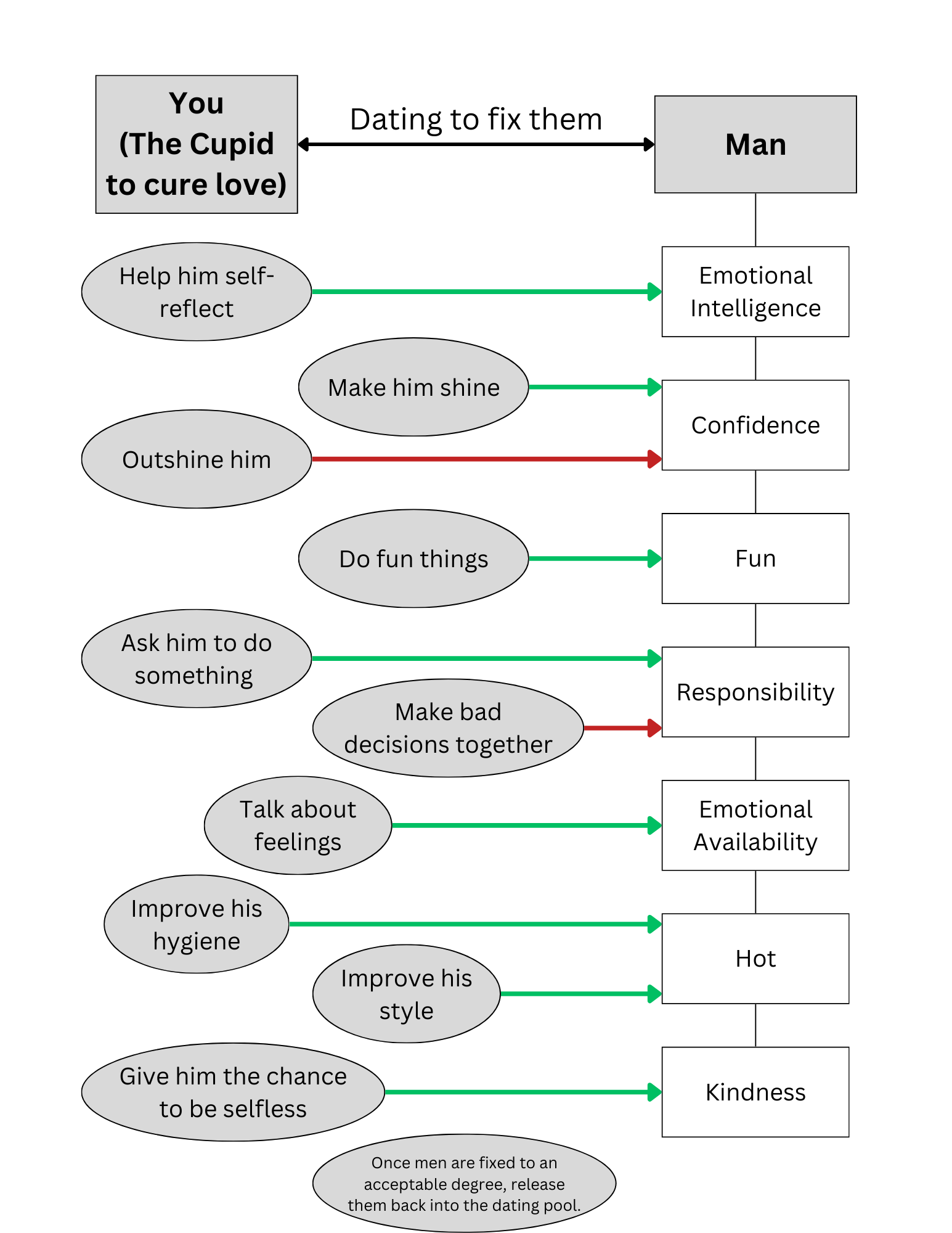
Both maps represent the main idea of “fixing” men through various interventions, capturing the process of dating and developing traits. The concept of “Fiximupim” serves as the central focus in both, connecting the various categories of actions that influence a man’s traits.
One key abstraction is the reduction of complex emotional and behavioral processes into simplified categories like “Trait Management” and “Men Type Selection” in the first map and specific actions like “Help him self-reflect” or “Give him the chance to be selfless” in the second. These abstractions make it easier to visualize the process of changing behaviors through structured interactions rather than detailed psychological intricacies.
The two maps share similarities in categorizing the types of actions (activities, conversations) and their effects on specific traits like confidence, responsibility, and emotional intelligence. Both maps connect certain actions directly to specific traits, showing a cause-and-effect relationship between behaviors and personality development.
However, the first map uses a color-coded structure, emphasizing different clusters (traits, activities, and men types) in a more organic, interconnected way. This layout captures the multifaceted approach to character development. The second map, by contrast, has a linear flow that shows the transformation process, guiding the viewer step-by-step through each action and its intended impact on the man’s traits. This layout represents a more direct, sequential pathway to “fixing” the men before “releasing” them back into the dating pool, adding a procedural dimension absent from the first map. Together, these maps provide complementary perspectives on the same theme.
Results